 Elite AI hackers aren’t born. They’re trained.
The Cyber Economy Is About to Change
Time-to-Exploit is Faster than Ever. Can Offensive Security Keep Up?

Time-to-Exploit is Faster than Ever. Can Offensive Security Keep Up?
We’re in the business of stopping attackers. But to give credit where credit is due… hacking is a tough job.
Finding novel vulnerabilities, chaining exploits, and adapting attacks to complex, living production systems requires elite talent. The time and environment needed to train that skill set is a limiter on the effectiveness of hackers, even at the nation-state level. Or at least, it used to be.
In a game where the defenders have to protect everything, but the attackers only need to succeed once, the defense has to take every advantage it can get. The skill barriers to true offensive tradecraft have kept us safe as much as any tool or defensive framework.
AI is changing all that.
After spending two decades in offensive and defensive cybersecurity, I’ve learned that the most important shifts in our industry rarely come from a single breach or a single new tool. They come from changes in economics. And advanced AI systems are already lowering the cost of attacks by reducing the expertise and resources required to execute them; meaning they are more efficient, more pervasive, and much, much faster.
What once required a team of elite researchers can increasingly be automated by AI agents capable of reasoning about code, infrastructure, and system behavior.
And automation means speed, increasing at an exponential rate:
- An average of 1.6 days TTE (time-to-exploit)
- Data exfiltration beginning within 4 minutes of initial access
- 89% YoY increase in attacks by AI-enabled adversaries
We are moving from manual offense to offense at scale.
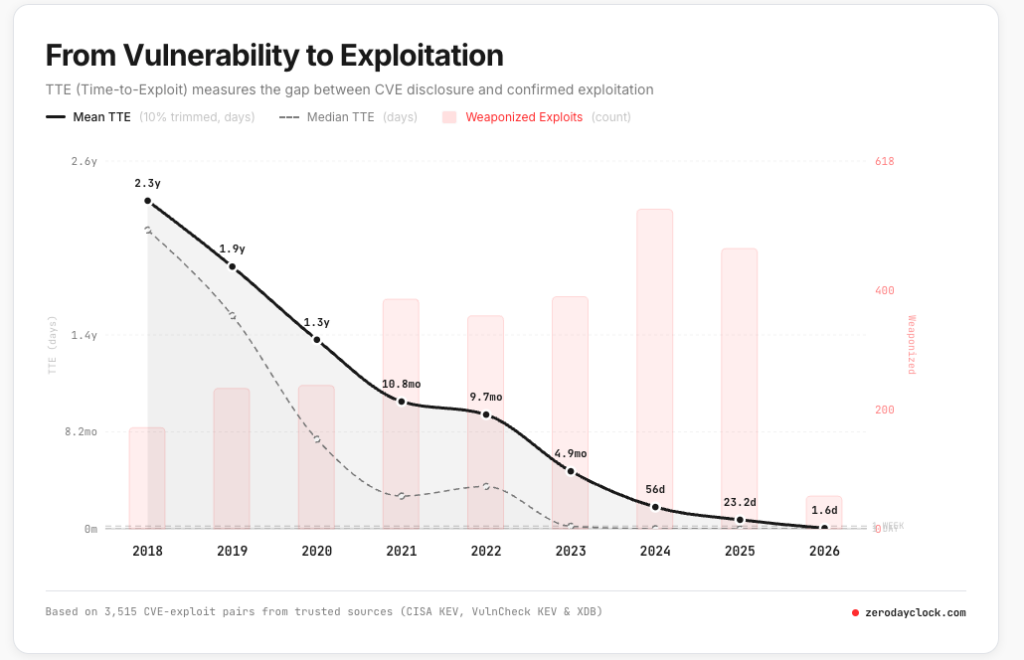
Image credit: https://zerodayclock.com/
What Falls into the Gap Between Offense and Defense?
The immediate consequences of this shift are twofold:
First, the number of attackers will grow. When the cost of an attack drops, more actors enter the market.
Second, the attack surface will become economically viable to explore in ways that were previously impractical. AI can probe thousands of targets simultaneously, exploring edge cases and combinations that humans simply would not have the time to test.
If you look at it purely through an economic lens, the cost of offense is collapsing. In contrast, unfortunately, most defensive architectures were built for a different era. Their costs are staying high, and getting higher as they try to keep up.
Many organizations still rely on periodic security testing, static analysis, and alert-heavy monitoring systems. These approaches generate reports and findings, but they often fail to answer the most important question:
Is this actually exploitable in the real system?
According to the 2026 CrowdStrike Global Threat Report, signature-based detection is increasingly irrelevant as more than 50% of attackers “live off the land,” blending into authorized activity. In other words, attackers don’t sit in front of reams of source code and trawl for bugs. They break through identity layers and exploit live, running systems.
That means effective defense must move beyond theoretical vulnerability detection and toward continuous validation of exploitability in real environments.
What Comes Next?
The organizations that win in the next decade will not be the ones that generate the most alerts. They will be the ones that continuously test their systems the way attackers do, discovering novel weaknesses before adversaries can weaponize them.
Because in the era of AI-driven cyber offense, the only sustainable strategy is simple:
Find the vulnerabilities before attackers do. And do it continuously.
Novee trades signal noise for validated exploits. Our decades of offensive tradecraft experience, with the speed of a powerful, custom-built AI model. Let us show you how your attackers think. Book a demo.